
Joppatowne, Harford County, MD
Paver Patios for Joppatowne Waterfront and Interior Yards
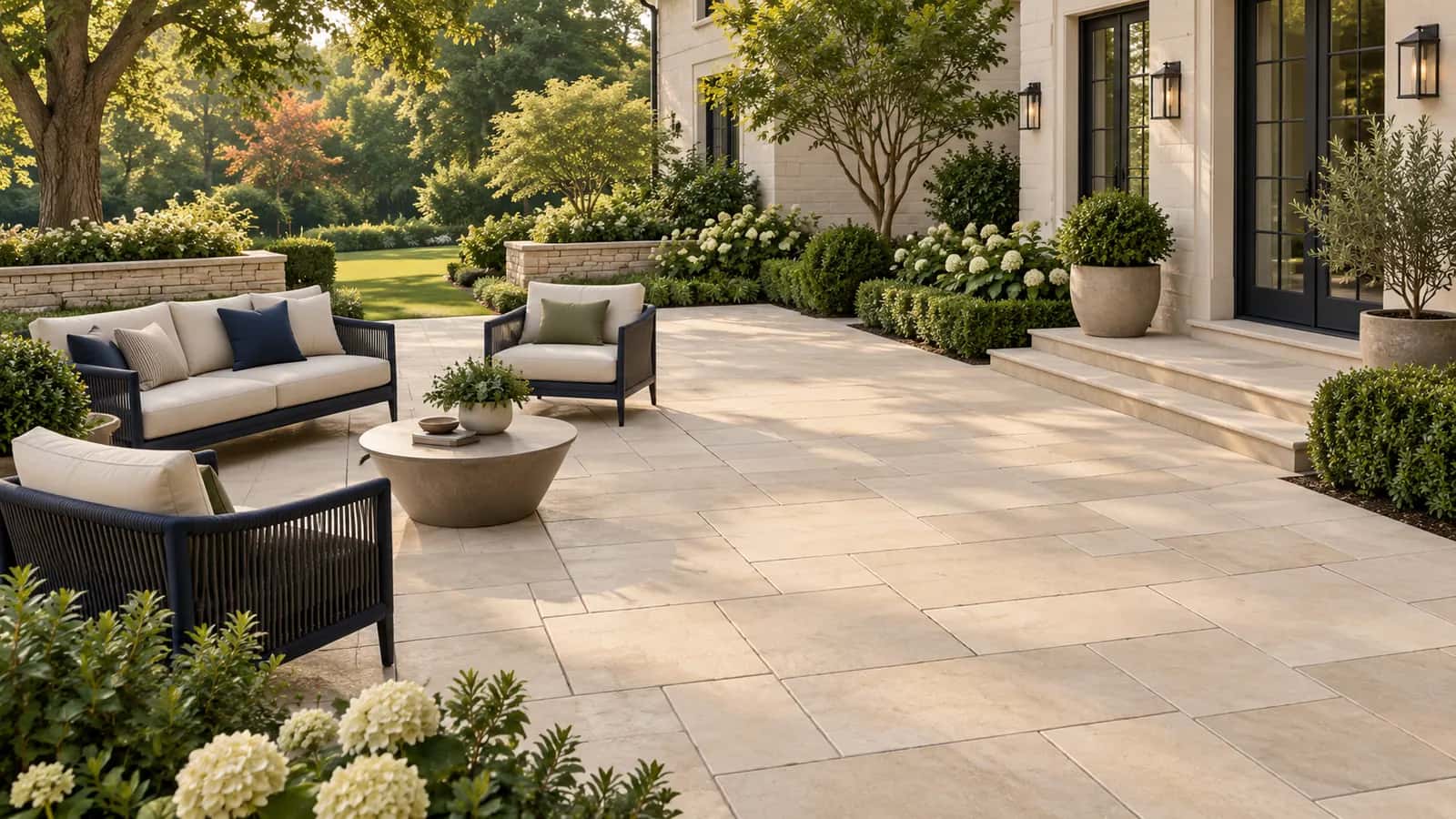
A Joppatowne back yard often ends at a canal or the Gunpowder River, and the original concrete slab behind the 1960s rancher or split-level has cracked and settled in the wet ground. Roso replaces those slabs with concrete paver patios, walkways, steps, and seating walls, built on a base that handles low, damp soil and pitched so water does not pool against the house.
Joppatowne is unincorporated, so Harford County is the public authority, and the county has not published a rule requiring a building permit for a patio on grade. What does apply on most waterfront and canal lots is the Chesapeake Bay Critical Area: a patio is new lot coverage that must be mitigated with plantings and documented on the county's Lot Coverage Form, and it must stay out of the shoreline buffer. We confirm both for your lot before design.
Planning locally
What to know before building a patio in Joppatowne
- County guidance on patio permits
- Harford County publishes permit guidance for decks, fences, and accessory structures but no published requirement for an uncovered paver patio on grade, so in most cases no building permit is needed. Retaining walls, regrading, and work inside recorded easements can still bring county review. This is county guidance and we confirm with the Permit Center for your property. Source: Harford County Department of Inspections, Licenses and Permits, Permit Center
- Critical Area lot coverage and shoreline buffer
- Within 1,000 feet of the Gunpowder River and its canals, a paver patio is new lot coverage. Harford County's Critical Area program requires mitigation, generally one tree or two shrubs per 100 square feet, documented on a Lot Coverage Form, and construction must stay out of the shoreline buffer. How the county counts permeable pavers is something we ask rather than assume. Much of Joppatowne is within the zone. Source: Harford County Chesapeake Bay Critical Area Program
- Floodplain and drainage on low lots
- The lowest lots along the river and Foster Branch lie in the mapped floodplain, where the county can review grading and fill. Even outside it, yards near the canals sit close to the water table and drain slowly. We keep regrading minimal, pitch the patio away from the house, and use a well-drained base so the pavers do not heave. We check the floodplain map for your parcel. Source: Harford County Department of Inspections, Licenses and Permits, Permit Center
Requirements vary by property and change over time. We confirm the current rules for your address as part of every estimate rather than assuming.
Design and materials
Patios that suit Joppatowne homes
What Roso builds
- Concrete paver patios
- Walkways and front entries
- Seating walls and steps
- Fire pit areas
- Patio expansion and replacement
- Replace the cracked 1960s slab with pavers at the same level
- Most Joppatowne ranchers have an original concrete slab off the rear door that has cracked and tilted. Pavers laid at the same finished height on a new compacted base give a flat, dry surface that can be lifted and reset if the wet ground ever moves again. We keep the patio an inch or two below the door sill and pitch it away from the house.
- Two small levels for a split-level yard
- Split-levels often have a lower door at grade and a kitchen door several feet up. A small landing patio at the upper door with wide steps down to the main patio ties the two together, and a low seating wall between the levels doubles as a retaining edge. Keeping each level modest limits new lot coverage where the Critical Area applies.
- Base for wet, low-lying soil
- Yards near the canals stay damp and the soil is often soft below the topsoil. We excavate to firm material, compact a thicker open-graded stone base than an upland site would need, and use polymeric joint sand so the surface stays tight through freeze-thaw. A perforated pipe at the low edge carries water toward lawn rather than letting it sit under the pavers.
Scope and estimate
What shapes a patio estimate
We price after a site visit, not from a form. These are the factors your written estimate will itemize.
Square footage
Larger patios cost more overall but usually less per square foot.
Paver selection
Standard concrete pavers are the most economical; premium textures, large-format slabs, and natural stone cost more.
Base and drainage work
Poor soils, deeper base, drains, and regrading add excavation and material.
Walls, steps, and borders
Seating walls, steps, contrasting borders, and inlays add material and skilled labor.
Access and demolition
Tight access for equipment and removal of an existing slab or patio add time.
Pattern complexity
Simple running-bond patterns install faster than herringbone, circles, or multi-size random patterns.
How it works
From estimate to finished patio
Step 1: Estimate request
Tell us how you want to use the space, the rough size, and your ZIP code.
Step 2: Site visit and layout
We measure, check slope and drainage patterns, mark a proposed footprint, and discuss paver styles and features.
Step 3: Written estimate
Square footage, paver selection, walls, steps, and drainage work itemized so you can adjust scope.
Step 4: Approvals and materials
We check for HOA, grading, or Critical Area requirements where they apply and order materials once approved.
Step 5: Excavation, base, pavers, walkthrough
Excavation, compacted base, bedding, paver installation, edging, joint sand, cleanup, and a walkthrough with you.
FAQs
Patios in Joppatowne: your questions
Answers specific to patio projects in Joppatowne. General patios questions are covered on our main patios page.
In most cases no. Harford County publishes permit guidance for decks, fences, and accessory structures, but we have not found a published requirement for a building permit on an uncovered paver patio laid on grade. Retaining walls, regrading, and work inside recorded easements can still bring county review, and lots in the Chesapeake Bay Critical Area must document new lot coverage. We confirm with the Permit Center for your property before scheduling, and inside the Town of Bel Air we check with the town instead.
Harford County's Critical Area program applies to land within 1,000 feet of tidal waters, including the Bush River, the Gunpowder River, and their tidal creeks. New lot coverage inside that zone must be mitigated with plantings, generally one tree or two shrubs for every 100 square feet added, and a Lot Coverage Form goes in with the application. Whether your lot is in the zone depends on its distance from tidal water, so we confirm it for your property before design. Roso prepares the coverage figures and the planting plan for the submittal.
No. Harford County's Critical Area program keeps construction out of the shoreline buffer along tidal water, and canal lots are treated as waterfront. The patio stays against the house and within the buildable part of the yard, with lawn or plantings between it and the bulkhead. We measure the buffer for your lot and confirm the allowable footprint with the county before drawing, and we design the planting so it also counts toward coverage mitigation.
On the lowest lots along the Gunpowder River and Foster Branch, the county can review grading and fill in the mapped floodplain, and a patio built at grade with minimal regrading is the usual way through. Most Joppatowne lots are above it. We check the floodplain map for your parcel and confirm with the county what applies before we set the patio elevation.
Not if it is built for the conditions. We excavate to firm soil, use an open-graded stone base that drains rather than holds water, pitch the pavers away from the house, and run a perforated pipe at the low edge toward lawn. The result usually drains better than the lawn it replaces. On the wettest lots we keep the patio smaller and use permeable joint material.
Most Joppatowne patios take three to six days of on-site work, including removal of the old slab, depending on size and whether a wall or steps are included. Wet ground can slow excavation, and we schedule around it. Critical Area paperwork comes before scheduling on lots in the zone. We give you a realistic start window with the written estimate.
Free estimate
Request a free patio estimate in Joppatowne
Tell us about your Joppatowne project. We'll follow up to schedule a site visit and send a written estimate.
What happens next
- Tell us about your project. Send the estimate form or call. Share your project type, ZIP code, and what you have in mind so we can prepare for the conversation.
- Site visit and measurements. We walk the property with you, measure, check grade and access, and talk through layout, materials, and anything that affects cost.
- Written estimate. You receive a written estimate that spells out scope, materials, and price so you can compare options and ask questions before deciding.
- No cost, no obligation
- Your details are used only to discuss your project
Prefer to talk? (410) 871-8175
More in and around Joppatowne
Ready to plan your Joppatowne patio?
Send a few details and we'll follow up to schedule a site visit and prepare a written estimate. No cost, no obligation.